

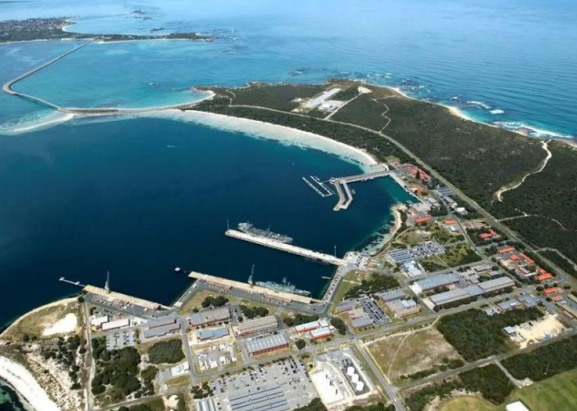
The NCIS-3 project (Stage1) consists of 14 stages providing the first phase of essential landbased facilities and infrastructure across the base at HMAS Stirling and Henderson. primarily to support the introduction into service of the Maritime Operational Support Capability (MOSC), the Arafura Class Offshore Patrol Vessel (ACOPV) and the Hunter Class Frigate (HCF).
The project stages were split across two sites, HMAS Stirling and Henderson located within the Australia Marine Complex.
Within our scope, across all the buildings Firesafe designed, installed and commissioned:
- Fire Sprinkler systems in accordance with AS2118-2017
- Pre-Action Fire sprinkler systems in accordance with AS2118
- Fire Hydrant systems in accordance with AS2419.1-2005
- Fire Hose Reel Systems in accordance with AS2441-2005
- Smoke Detection systems
- Aspirating Smoke Detection systems
- Building Occupant Warning systems in accordance with AS1670.1-2018
- Fire Pumps in accordance with AS2941
- Fire Water Storage Tanks in accordance with AS2304
- Portable Fire Extinguishers and Fire Blankets in accordance with AS2444 – 2001
6.5 Building B0230 The OFSF-W is a two-story multi-use (office and accommodation) building with rooftop plant level and consists of a western wing which accommodates the open plan working accommodation and a smaller eastern wing which accommodates the Duty Watch facilities. The central ‘link’ accommodates the main entry, reception, first aid room, office amenities circulation stair and shared brew.
6.2 Building B0240 is a three-storey training centre with rooftop plant level. It consists of a northern wing and a smaller glazed wing to the south. The northern wing accommodates teaching / learning space classrooms at one end, with offices and specific practical training rooms at the other, including the Command Team Trainer, Machine Control Room Training and Bridge Simulation.
6.8 Building A0008 (Henderson)
The CCCS comprises a 2-storey (ground and first floor) office accommodation building with an enclosed consolidated building services plant room on the second floor. The height of the 2-storey component sits at 10.2m and an overall height including the plant room level of 13.7m. The CCCS contains an approximate floor area of 18000m2 (including plant room, excluding outdoor areas).
Stage 1: Living in Accommodation (Permanent) Building A0118
The live in accommodation comprises a six-story structure designed to accommodate the growing crew of the MOSC Vessel at HMAS Stirling. It includes a block of 71 individual units for senior sailors, each with exclusive occupancy, along with ground-level parking allocated for each unit.
Stages 8.1a, 8.1b and 8.1c Buildings A0135/A0136&A0137
The above stages comprise of three six-storey facilities providing additional accommodation at HMAS Stirling for the increased Trainees associated with the ACOPV training activities. It includes three blocks of 96 sole occupancy units for trainees.
Stage 8.3a Building A0134
Stage 8.3a comprises of a six-storey facility providing additional accommodation at HMAS Stirling, consisting of 62 sole occupancy units for Junior Sailors.
Stage 8.3b Building A0140
Stage 8.3b comprises of a two-storey car park facility providing car parking for 8.3a A0134 accommodation.
Fire Sprinkler Systems:
The fire sprinkler systems were installed to Buildings 6.2, 1.0, 8.1 A/B/C and 8.3A.
The sprinkler system is a conventional wet pipe sprinkler system. The system consists of a network of pipework and valves designed to distribute a design concentration of water to the exact location of the fire source. The fire is detected by a heat sensitive element (Frangible Glass Bulb) that forms part of a standard sprinkler head. The sprinkler head installed in the vicinity of the fire source and affected by the fire operates, releasing water onto the fire. If the fire is not controlled by the operation of a single sprinkler, further sprinklers will progressively open until control is achieved. Operation of any sprinkler head causes a local alarm signal to be sent to the fire monitoring Control
and Indicating Equipment – CIE (FIP).
Additionally, operation of any sprinkler head, fire hose reel or fire hydrant will automatically start the fire booster pumps which are located in the Fire Pump Room located externally.
Once the fire booster pumps start, they can only be turned off manually at the fire pump control panel located within the fire pump room. On activation of the fire pumps a signal is sent to the Main Fire Indicator Panel (FIP) located on the Ground Floor in the FIP cupboard of Building B0240.
Sprinkler Control Valve Sets have been installed to Buildings 6.2, 1.0, 8.a A/B/C & 8.3A
within the Sprinkler Control Valve rooms located on the Ground Floor of each building. The fire systems are fed from new dedicated site infrastructure locally to each building comprising of a galvanised rectangular tank with two no. compartments and two no. Diesel Fire Pump Sets (Duty & Standby)
Pre-Action System:
The Pre-Action system consisting of a pre-assembled nitrogen generator within Buildings
6.2 and 6.8 are contained in a compact cabinet located in the Sprinkler Control Valve Room.
The Pre-Action system within 6.5 is maintained via an air compressor and located within 6.5 in the SCV cupboard on the ground floor. These Pre-action systems operate on a double interlock basis where it requires a fire signal from an ASD along with activation of a sprinkler head for the pre-action system to fill with water. These systems were installed to highly
sensitive areas to mitigate the operation of the system in the case of accidental damage.
Activation of the fire sprinkler or pre-action system will cause a local alarm signal to be sent to the fire panel and the fire services.
Fire Hydrant system:
Fire Hydrants have been installed to cover Buildings 6.2, 6.5, 6.8, 1.0, 8.1 A/B/C, 8.3 A & B and are installed externally on the Ground Floor and within fire stairs on each level. In some instances, satellite hydrants are located on the floor space. The water supply for the hydrant system is combined with the fire sprinkler system.
Fire Hose Reels:
Fire Hose Reels have been installed in Buildings 6.2, 6.8, 1.0 & 8.3B and form part of the
combined fire sprinkler/fire hydrant system. Upon activation of a hose reel the fire pumps may start, a pump run signal will be sent to the Main FIP.
Water Supplies:
B0243
B0243 is a dedicated Fire Pump Room located adjacent to Building 6.2 B0240 and houses two new Diesel Fire Pump Sets (Duty & Standby) which feed the new fire systems within B0240. A jockey pump is installed alongside the fire pumps to negate any small fluctuations in system pressure. These fire pumps are designed and installed to AS2941.
An annubar test line complete with influx flow meter has been installed to allow for yearly compliance testing.
The fire pumps are fed by a new galvanised rectangular fire water storage tank split into two compartments located next to B0243. The overall dimensions of the tank are 10m x 9.5m x 4m high with and overall capacity of 345kL.
The infills to the tanks have been taken from the southern island domestic water supply and contain automatic quick-fill valves to allow for automatic filling of the tanks should the water levels drop.
A0009
A0009 is a dedicated Fire Pump Room located at the entrance to site and houses two new
Diesel Fire Pump Sets (Duty & Standby) which feed the new fire systems within A0008. A jockey pump is installed alongside the fire pumps to negate any small fluctuations in system pressure. These fire pumps are designed and installed to AS2941. An annubar test line complete with influx flow meter has been installed to allow for yearly compliance testing.
The fire pumps are fed by two. new galvanised cylindrical fire water storage tanks split into two compartments located next to A0008. The overall dimensions of the tank are 8.8m dial x 5m high with a capacity of 180kL each. The infills to the tanks have been taken from the water corporation towns main and contain automatic quick-fill valves to allow for automatic filling of the tanks should the water levels drop.
A0121
A0121 is a dedicated Fire Pump Room located adjacent to LIA 1.0 A0118 and houses two new Diesel Fire Pump Sets (Duty & Standby) which feed the new fire systems within
A0118
A jockey pump is installed alongside the fire pumps to negate any small fluctuations in system pressure. These fire pumps are designed and installed to AS2941. An annubar test line complete with influx flow meter has been installed to allow for yearly compliance testing.
The fire pumps are fed by a new galvanised rectangular fire water storage tank split into two compartments located next to A0121. The overall dimensions of the tank are 10m x 10m x 4.5m high with and overall capacity of 385kL.
The infills to the tanks have been taken from the southern island domestic water supply and contain automatic quick-fill valves to allow for automatic filling of the tanks should the water levels drop.
A0138
A0138 is a dedicated Fire Pump Room located adjacent to LIA 8.1a A0135 and houses two new Diesel Fire Pump Sets (Duty & Standby) which feed the new fire systems within A0135/A0136 & A0137. A jockey pump is installed alongside the fire pumps to negate any small fluctuations in system pressure. These fire pumps are designed and installed to\
AS2941
An annubar test line complete with influx flow meter has been installed to allow for yearly compliance testing. The fire pumps are fed by a new galvanised rectangular fire water storage tank split into two compartments located next to A0138. The overall dimensions of the tank are 10m x 10m x 4.5m high with and overall capacity of 185kL.
The infills to the tanks have been taken from the southern island domestic water supply and contain automatic quick-fill valves to allow for automatic filling of the tanks should the water levels drop.
A0139
A0139 is a dedicated Fire Pump Room located adjacent to LIA 8.3b A0140 and houses two new Diesel Fire Pump Sets (Duty & Standby) which feed the new fire systems within A0134 and A0140. A jockey pump is installed alongside the fire pumps to negate any small fluctuations in system pressure. These fire pumps are designed and installed to AS2941. An annubar test line complete with influx flow meter has been installed to allow for yearly compliance testing. The fire pumps are fed by a new galvanised rectangular fire water storage tank split into two compartments located next to A0139. The overall dimensions of the tank are 12m x 12m x 4m high with and overall capacity of 480kL. The infills to the tanks have been taken from the southern island domestic water supply and contain automatic quick-fill valves to allow for automatic filling of the tanks should the water levels drop.
Smoke Detection System:
The Fire Detection system has been installed to alert occupants to possible fire conditions by initiation of Alert and Evacuation tones to enable early egress. The system consists of Honeywell FSP-951AUS throughout the buildings except for the communication rooms (on Phase 3) where Aspirating type Detection is utilised.
Main Fire Indicator Panels (MFIP) are installed within each Building within the main lobby which are Notifier AFP-3030 model which is consistent with the existing site wide fire network. Upon activation of a device such as a sprinkler system monitored valve or fire water tank level alarm a discrete alarm will be received at the FIP. A Red Strobe Light and Bell is located outside the front entrance to enable fire fighters to easily locate the FIP.
Photoelectric smoke detectors have been installed with the purpose to sense smoke, these are programmed into the fire control panel. Thermal smoke detectors are also installed to alert energy emission from a fire in the form of heat with the Thermal Heat Detector set to 57C. The fire panels are fully integrated with the existing master fire brigade panel via the ICT site-wide network.
Aspirating Smoke Detection System (Phase 3):
Aspirating smoke detection has been provided in the CF2 space and communication rooms to provide earlier response to smoke to shorten the response time. The ASD is controlled and monitored by the Fire Control Panel via analogue addressable loop.
Building Occupant Warning System:
The Building Occupant Warning system (BOWS) has been installed, controlled and operated by the Fire Alarm Control Panel located in each building at Ground Floor.
The system broadcasts evacuation tones throughout the building and sends an alarm signal to DFES Remote Monitoring Centre (Stage 6.8 only). During non-emergency situations the system can have the PA channel or BGM channel switched to enable the OWS to be used for PA facilities.